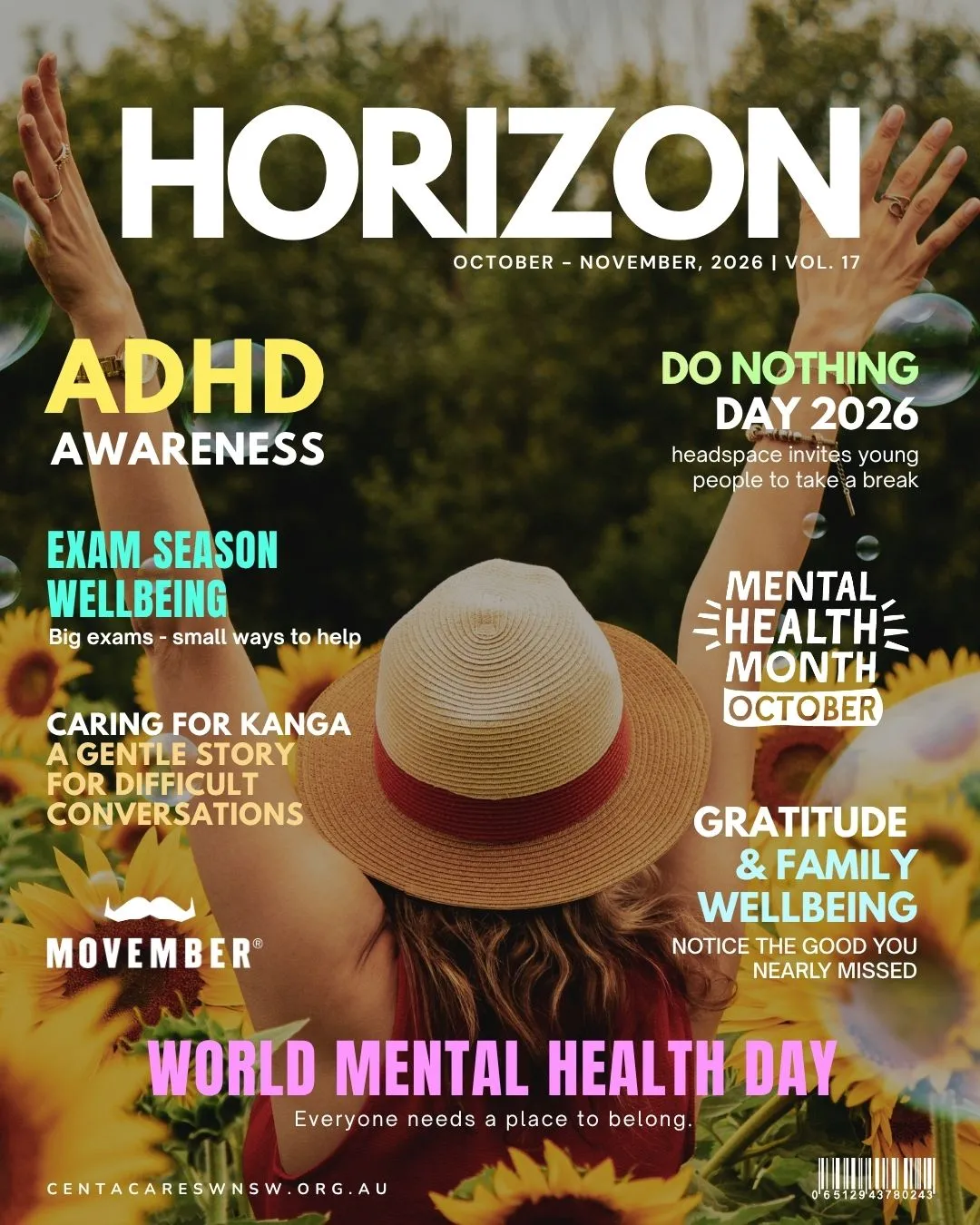
Horizon Vol.17 • October - November, 2026
Making space for mental health in everyday life
01
Celebrating a community of support
Explore ADHD through art, stories & humour, or share your own perspective this month
02
How to support your child through exam season
Psychologist Georgia shares practical ways to help your child manage exam pressure.
03
What it means to thrive together
How to help people feel included and supported this World Mental Health Day.
04
Practical tools and local connections for mental wellbeing
FREE wellbeing resources & a community lunch in Griffith this Mental Health Month.
05
Make room to do nothing*
headspace invites young people to take a break from the pressure to keep doing.
06
A little mo can make a big difference
Grow, move or gather your mates. Everyone can get involved in Movember.
07
Slow down to see the good
Simple ways to notice the good and share moments of gratitude with your child.
08
A gentle story for life after disclosure
Millie shares the story behind Caring For Kanga, a book about life after disclosure.
Fin.
Free webinars & upcoming courses
The Stories
Image: Musings of an ADHDer by Shayne Swift
ADHD Awareness Month - October
Celebrating a community of support
A picture, a personal story or a well-timed meme can offer another way to understand ADHD. This October’s theme, ‘A Community of Support’, invites everyone to take part.
Understanding can begin with a conversation: asking someone about their experience, listening to what they need, or finding reliable information to explore together.
The ADHD Awareness Month Coalition works with organisations around the world to share reliable information about ADHD and its treatments. Alongside that information, it makes space for people to describe life with ADHD in their own way.
This year’s theme, ‘A Community of Support’, is an invitation to listen, connect and contribute. You don’t need to be an expert to join in.
See ADHD through art
Explore the art people have shared, or submit your own. The collection offers a creative window into how others see and express their ADHD.
Read a story, share a perspective
Personal accounts give us a chance to hear directly from people living with ADHD. Browse the stories collection, or share what you would like others to understand about your life.
Make room for a chuckle
Sometimes humour gets the point across. Visit the ADHD meme wall for a chuckle, a moment of recognition, or inspiration to submit your own.
Whether you browse or contribute, there are several ways to get involved this October.
If you’re seeking answers for yourself or your child, Centacare offers ADHD assessments and diagnosis for adults and children in Wagga Wagga and Albury.
Reliable information helps us ask better questions, understand each other and explore what support might help.
- Centacare South West NSW
Ask about ADHD assessment
Assessment clinics located in Wagga & Albury
Image:
Exam wellbeing
How to support your child through exam season
Exam pressure can build quickly. Psychologist Georgia shares practical ways to support your child during exam season, helping them manage stress and look after their wellbeing.
You cannot take away every exam worry, but you can help your child keep the pressure in perspective and find ways to make study more manageable.
Stress around exams is normal. The aim is not to eliminate it completely, but to help your child cope when the pressure builds.
Make study manageable
- Help them break study into smaller tasks and plan their time realistically.
- Encourage them to work through one problem at a time.
- Focus together on what they can influence, rather than everything that might go wrong.
Protect the basics
- Encourage enough sleep, regular meals and physical activity.
- Help them make room for breaks in their study plan.
- Support time with friends and activities they enjoy. These can help them cope with study pressure.
Keep things in perspective
- Listen to worries such as “I’m going to fail” without dismissing how they feel.
- Help them find a more balanced thought: “I can only do my best with the time I have.”
- Give them space to talk without expecting them to feel positive all the time.
Know when to seek support
- Check in regularly and ask what support would help.
- Seek support if stress becomes overwhelming or starts interfering with everyday life.
Centacare South West NSW’s psychology team supports children, teens and young adults with concerns including school stress and anxiety.
Stress around exams is normal. The aim is not to eliminate it completely, but to help your child cope when the pressure builds.
- Centacare South West NSW
Contact our psychology team
Support is available if exam pressure starts getting in the
Image:
World Mental Health Day - October 10
What it means to thrive together
This October, Australia’s Together We Thrive campaign invites us to think about the communities we create, and how everyday care can make room for everyone.
A neighbour notices you have been quiet lately. A colleague makes time to listen. Someone remembers to invite you, even when you usually say no.
These moments can seem small. Yet they say something meaningful: you belong here, and how you are doing matters.
World Mental Health Day falls on 10 October, during Mental Health Month. Mental Health Australia’s 2026 national campaign theme, Together We Thrive, places connection at the centre of the conversation.
But what does thriving look like for a community?
It might mean a school where a young person can ask for help without embarrassment. A workplace where someone can speak honestly about struggling. A local group that welcomes newcomers and notices who might be missing.
Thriving also means making room for people whose lives, needs and experiences differ from our own. It asks us to listen without assuming we already understand.
We do not need to have every answer to offer care. We can ask how someone is going, give them time to respond and check in again. We can make an invitation easier to accept by offering a lift or suggesting a short walk.
Connection sits alongside practical help and professional support. A caring community makes space for both, recognising that people need different things at different times.
This October, consider one connection you could strengthen. Someone you could include. A conversation you could make time for. Together, we can help create communities where asking for support feels welcome, and everyone has a place.
A thriving community makes room for people to be honest about how they are doing, ask for support and know they belong.
-
Explore Together We Thrive
Find ideas for starting conversations and strengthening connections in your community.
Image:
National Mental Health Month - October
Practical tools and local connections for mental wellbeing
This October, explore Black Dog Institute’s online mental health resources and an opportunity to connect over lunch in Griffith. There are practical starting points for young people, adults and those
You might be looking for ways to manage everyday stress, help a young person with sleep, or make sense of how you’ve been feeling.
Mental Health Month encourages us to better understand mental health, talk more openly and explore the support available.
Free tools to try
Black Dog Institute offers online resources for different ages and needs. Whether you’re exploring them yourself or alongside someone you care about, these tools provide several places to start.
- Youth Mental Fitness Hub brings together mental health and wellbeing resources for young people.
- Sleep Ninja is a free, evidence-based app that helps young people build skills to manage sleep problems.
- myCompass is a free online program to help you recognise unhelpful thoughts, feelings and behaviours, and learn practical ways to manage them.
- Healthy Mind is an Easy Read resource designed for people with intellectual disability to explore their thoughts and feelings.
Connect over lunch in Griffith – October 23rd
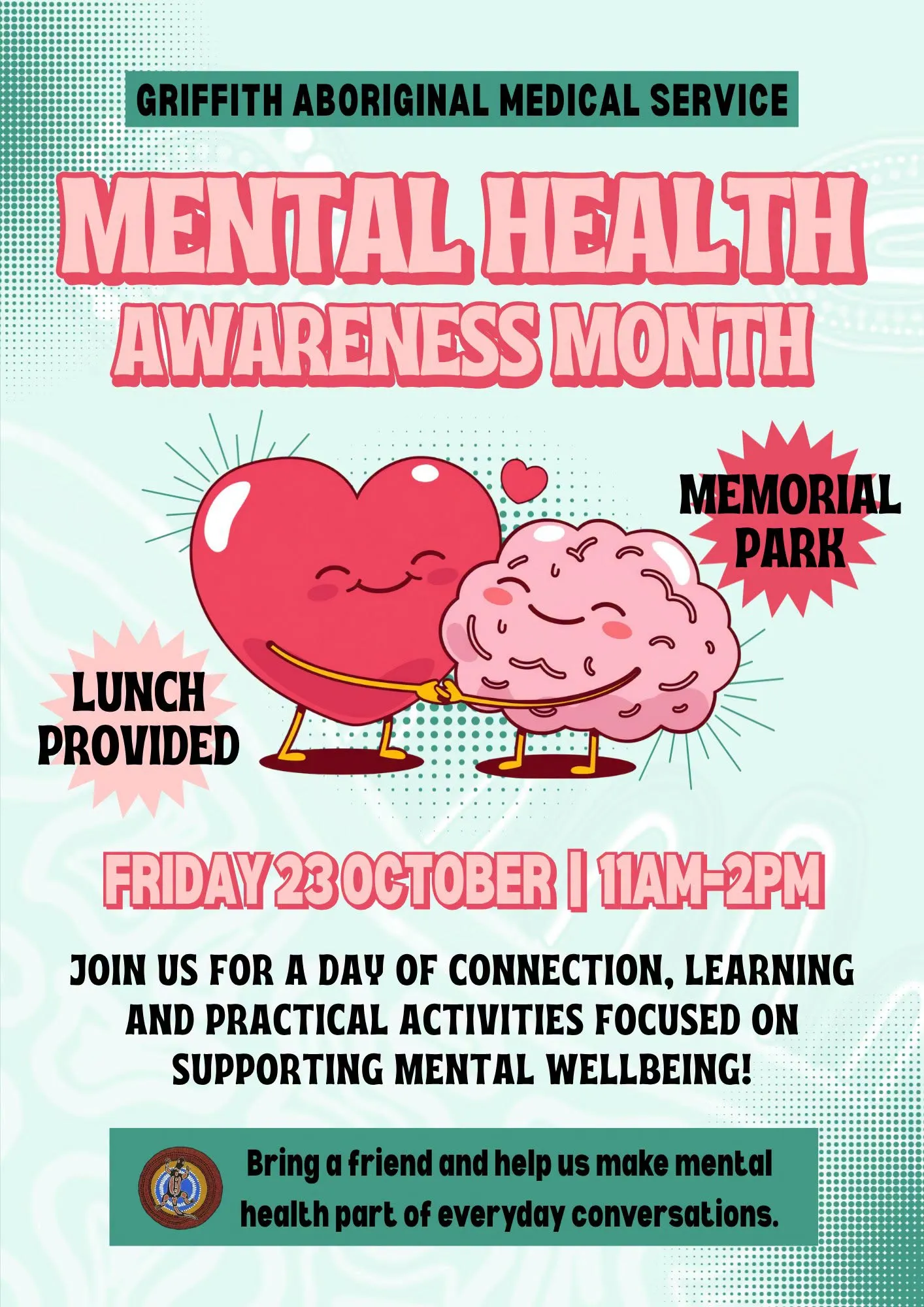 Griffith Aboriginal Medical Service invites you to Memorial Park on Friday 23 October, from 11 am to 2 pm. Join them for lunch, connection, learning and practical activities focused on mental wellbeing.
It’s an opportunity to come together locally, share a conversation and learn more about looking after your mental health.
Having somewhere to start can make reaching out feel more manageable. Reliable information, practical tools and connections with others can help us take that next step.
-
Explore the Griffith event
Find the event details and latest updates from Griffith Aboriginal Medical Service.
Image:
headspace Day - Wednesday October 14
Make room to do nothing*
This headspace Day, young people are encouraged to take a break from everyday pressures and make time to pause, recharge and reset.
Between school, study, work and keeping up with friends, young people can feel there is always something more to do. On Wednesday 14 October, headspace Day offers a reminder that making time for yours
What does ‘do nothing*’ mean?
The campaign invites young people to step away from the pressure to keep doing and achieving. Doing nothing* can mean choosing something simple that gives you a breather, without a task to finish or a goal to reach.
It might be listening to music, watching the sunset, spending time in nature or enjoying a meal without your phone. What feels restful will look different for everyone.
Find a moment, on your own or together
Start with ten minutes and choose something you enjoy. You could take a gentle walk, connect with Country, or sit somewhere comfortable and let your thoughts wander.
Taking a pause can also mean spending time with others. Play a board game, share a meal or chat with a friend without rushing to the next thing.
Parents and carers can help by making space for downtime in everyday routines, without expecting every moment to be productive.
Young people deserve time to pause, without feeling they should always be doing more.
-
Explore do nothing*
Find your way to take a pause. Explore headspace’s interactive activities and choose something that supports your mental health and wellbeing.
Image:
Men's Health
A little mo can make a big difference
Put down the razor and give your upper lip a purpose. Movember is nearly here, bringing a month of moustaches, movement and meaningful conversations about men’s health.
November is when the mo takes centre stage. From the carefully groomed to the gloriously patchy, every effort can help start a conversation that matters.
Behind the facial hair and friendly competition is a shared goal – helping men live healthier, longer lives.
You don’t need a tache to take part. Here are four ways everyone can get involved.
1. Grow a Mo
Start clean-shaven on 1 November and see what takes shape. Your mo might earn a compliment, a laugh or a question. Each is an opportunity to explain why you’re growing it.
Can’t grow a Mo? Give one of these a go!
2. Move for Movember
Walk or run 60 kilometres across November. Movember’s challenge remembers the 60 men lost to suicide globally every hour. Spread the distance across the month or tackle it with a friend.
3. Host a Mo-ment
Bring people together for a barbecue, trivia night or morning tea. Keep it simple, make it enjoyable and raise funds while you’re at it.
4. Mo Your Own Way
Set a personal challenge that suits you. Try a new activity, take a break from social media or work towards a personal best while gathering support for men’s health. Movember
A little moustache inspiration
Looking for a style reference? There’s Tom Selleck’s famously full mo, Freddie Mercury’s unmistakable look or Salvador Dalí’s gravity-defying whiskers.
Of course, a few determined hairs count too. Nobody’s expecting a masterpiece by the end of November.
Keep the conversation growing
The mo might get people talking, but what comes next matters too. Ask a mate how he’s going, make time to listen and stay in touch beyond November.
Whether you grow, move or gather people together, your involvement can help make men’s health easier to talk about and support Movember’s research and health programs.
Give Merv Hughes a run for his moustache this November.
-
Register for Movember
Choose your challenge, rally your mates and make November count for men’s health.
Image:
Parenting & wellbeing
Slow down to see the good
As another school year draws to a close, School Wellbeing Practitioner Grace shares a simple reminder for parents and carers: pause, notice the good and make space for gratitude together.
The final weeks of Term 4 can disappear in a blur of school concerts, reports, celebrations and lists of things still waiting to be done.
When family life gets busy, it is easy to move from one task to the next without noticing how far you and your child have come.
Slowing down can be as simple as noticing your child laughing, a kind word or a small moment you enjoyed together.
Try three things together
At the end of the day, invite your child to name three things they are thankful for:
- something that made them smile
- someone who helped them
- a moment they appreciated.
Share your own, too, around the dinner table, on a walk or before bed. Keep it relaxed: some days, one thing is enough, and there is still room to talk about what was difficult.
Carry the good into summer
As the holidays approach, make room for rest, connection and reflection. You might remember something your child learned, a challenge they worked through or a kindness they showed.
The year does not need to have been perfect for there to be moments worth recognising. Sometimes the small wins and ordinary moments are the ones worth carrying with us.
The year does not need to have been perfect for there to be moments worth recognising together.
-
Explore parenting support
Looking for ways to support your child and strengthen family connection? Explore Centacare’s Parent Support Hub for parenting courses, webinars and individual support.
Image:
Supporting Children
A gentle story for life after disclosure
Drawing on her work with children and families, Centacare clinician Millie has independently written Caring For Kanga, a story about feelings, safety and finding support after sexual abuse.
After a child discloses sexual abuse, children and families can face difficult feelings, questions and changes that are not always easy to talk about.
In her work as a Child and Adolescent Sexual Assault Clinician, Millie supports children and families through this period. She saw a gap in resources that could help them understand what can follow disclosure.
That observation became Caring For Kanga, an independently written and published story for children, families and the wider community.
Through Kanga’s story, Millie hopes children will feel less alone and understand that their feelings are real, they are not to blame and they do not have to carry what happened by themselves.
For parents, carers and professionals, the book offers a gentle starting point for conversations about feelings, safety and support.
Caring For Kanga was independently written and published by Millie. It is not a Centacare South West NSW resource.
There are wonderful resources around prevention and body safety, but I wanted something that helped children and their people understand the confusing feelings, changes and experiences that can follow disclosure.
- Millie, Author Child and Adolescent Sexual Assault Clinician
Learn with us • October - November, 2026
Free webinars & upcoming courses
Practical, live sessions delivered by Centacare practitioners. Most webinars open to families right across Australia.
View the full calendar
Free webinars • Available Australia-wide
Parenting Challenges
Foundations for Safe Parenting
Free Australia-wide webinar exploring family and dv, coercive control, child wellbeing and practical safe parenting strategies.

Parent Wellbeing
Self-Care in Tough Times
Simple strategies to manage stress, build resilience and prioritise your wellbeing during challenging times.
Courses Coming Up