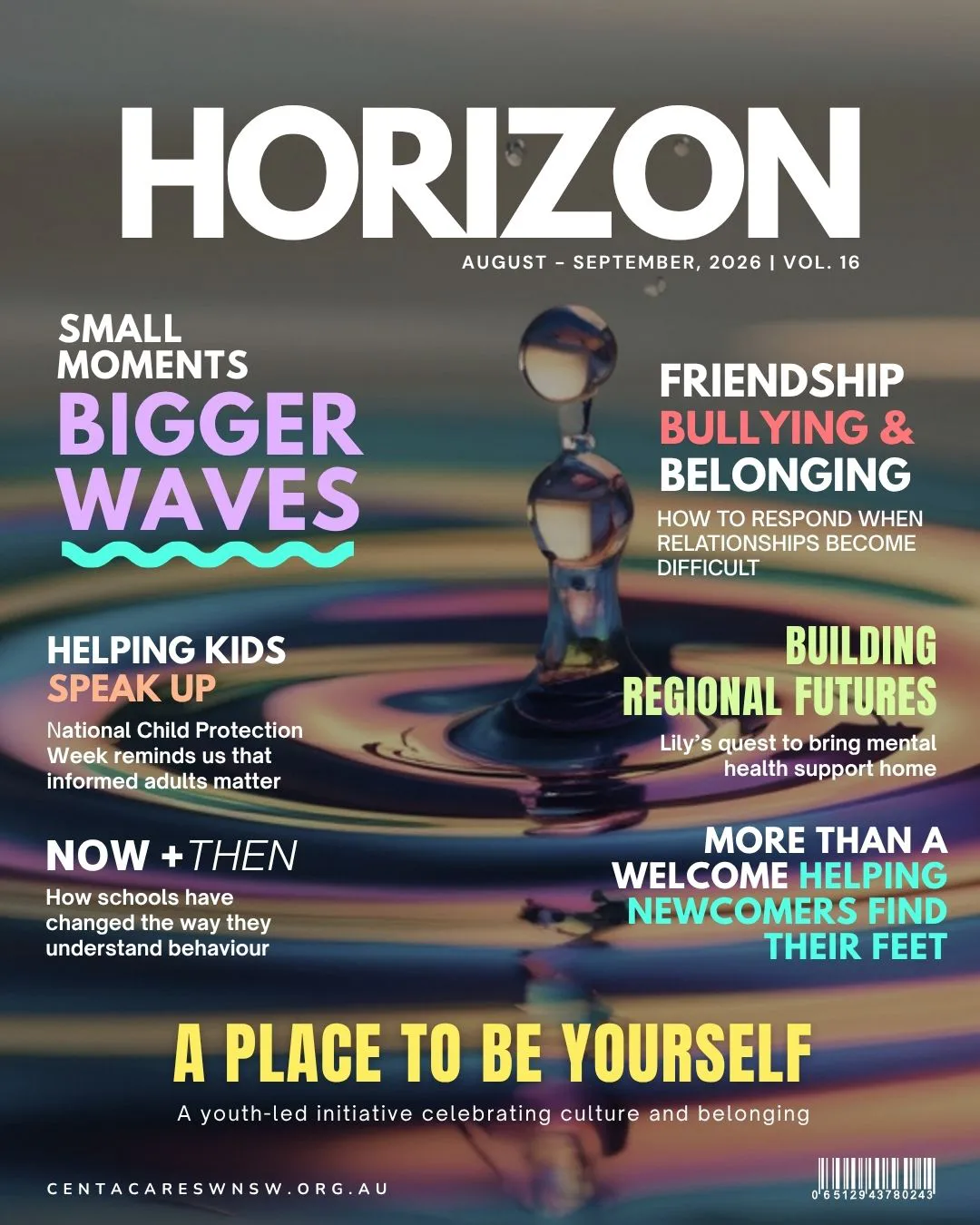
Horizon Vol.16 • August - September, 2026
The moments that move us forward
Some of the most important changes begin quietly: a conversation, an opportunity or a welcoming hand. This edition explores the ripples that follow.
01
Small conversations can have a big impact
Practical ways parents can respond when friendship problems become bullying.
02
Informed adults help children speak up
Child safety starts with adults who know how to listen and where to turn.
03
Young voices shaping a place to belong
A local youth-led initiative is creating space for culture, connection and belonging.
04
Lily’s scholarship supports her rural mental health goals
A Riverina student hopes to bring mental health support back to regional communities.
05
How school wellbeing has changed from 1991 to now
Looking beyond behaviour has changed how schools support students and families.
06
More than a welcome: support for new beginnings
Settlement support helps newcomers navigate life, services and community connections.
07
Service leaders strengthen their shared response
Regional providers joined sector leaders to tackle shared challenges and opportunities.
Fin.
Free webinars & upcoming courses
The Stories
Bullying No Way Week | 17-21 August
Small conversations can have a big impact
Bullying No Way Week is an opportunity to check in with your child about healthy friendships, how they feel around others and what they can do when relationships become difficult.
When a child tells us they are struggling, our first instinct may be to panic or immediately step in. Yet children are often more capable than we realise. By listening calmly and helping them consider
Test
method
Bullying No Way Week runs from 17 to 21 August 2026. This year’s theme, “Small Acts, Big Impact”, encourages families, schools and communities to consider how everyday responses can make a difference.
When friendship problems become bullying
Disagreements and friendship difficulties are a normal part of growing up, but bullying is different.
Bullying involves the deliberate and repeated misuse of power to cause physical, social or psychological harm. It may be verbal, physical or social and can happen in person or online.
A 2019 analysis of Australian research estimated that around 15 per cent of children experienced bullying within a 12-month period, while about 5 per cent reported bullying others. Many more witnessed it.
Connect before trying to fix it
Hearing that your child may be experiencing bullying can be upsetting. Try not to panic or rush into solving the problem for them.
Begin by listening, acknowledging how they feel and thanking them for telling you. These prompts can help you understand what happened while keeping your child involved:
Connect: “I’m really glad you told me. I’m here and I’m listening.”
Understand: “Can you tell me what happened?”
Identify a pattern: “Has this happened before? How often?”
Gather context: “Who was there, and did anyone see what happened?”
Check online: “Has anything been posted, messaged or shared?”
Validate: “That sounds really difficult. It makes sense that you felt upset, embarrassed or angry.”
Check safety: “Do you feel safe at school, online and travelling to and from school?”
Explore concerns: “What are you most worried might happen next?”
Build confidence: “What do you think could help?”
Consider options: “Is there anything you would feel comfortable trying?”
Identify support: “Is there an adult at school you trust?”
Problem-solve: “Would you like me to listen, or should we work out the next step together?”
Reassure: “You don’t have to handle this alone. We can decide what to do together.”
If your child does not want to continue, avoid pressing for every detail. Let them know you are ready to listen when they are ready.
Support without taking over
Children build confidence when supported to identify possible solutions and help decide what happens next.
This does not mean leaving them to manage bullying alone. Adults must act when there are safety concerns, serious threats or continuing harm. Explain what you need to do and keep your child informed.
Together, you might speak with a trusted teacher, year adviser, school wellbeing practitioner or another appropriate staff member. Record repeated incidents, including dates, locations, messages or screenshots, and keep checking in after reporting the matter.
Children who witness bullying may also feel frightened, guilty or unsure. Encourage them to tell a trusted adult and consider how they can support the child involved without putting themselves at risk.
When more support is needed
Bullying can affect a child’s confidence, friendships, learning and willingness to attend school. It can also leave parents unsure about when to step in or what to try next.
Centacare South West NSW offers several pathways for support:
The School Wellbeing Program works with schools through early intervention, student programs, counselling, group learning, parent engagement and educator support.
Centacare’s registered child psychologists support kids, tweens and teens experiencing bullying, friendship difficulties, school stress, anxiety, low confidence and other emotional or social challenges. Appointments are available in Albury and Wagga, with telehealth for regional families.
Counselling for kids, tweens and teens provides a safe place to discuss difficult experiences, understand feelings and develop practical ways to cope.
Individual parenting support and family counselling can help parents respond to challenging behaviour, strengthen communication and address concerns affecting the family.
Parents, schools and organisations can contact Centacare to discuss what is happening and find the right support.
Children are often more capable than they realise. When adults respond calmly and listen first, they help build the resilience and confidence that protect children long after the moment has passed.
- Grace, School Wellbeing Practitioner
Find the right support
Talk with our team about support for your child, family, school or organisation.
National Child Protection Week | Sept 6-12
Informed adults help children speak up
Child safety begins with adults who listen, recognise concerns and know where to find support. National Child Protection Week is an opportunity to revisit the tools and services available.
A child may not always have the words to explain what is wrong. How the adults around them listen and respond can make speaking up easier.
Turning conversations into action
From 6 to 12 September, National Child Protection Week invites Australians to consider the role we each play in keeping children and young people safe.
This year’s theme, “Every Conversation Matters, Shifting Conversation to Action”, reminds us that awareness is only the beginning. Adults also need practical knowledge: how to listen without judgement, recognise concerns and respond when a child reaches out.
The week is a useful time to revisit the many resources available. Some parents, carers and other trusted adults may not know where to begin until support is urgently needed.
Bravehearts Day – Friday September 11
Bravehearts Day falls during the week on Friday 11 September. Led by Bravehearts, an organisation whose founder has worked closely with Centacare in the past, the day raises awareness of child sexual abuse and encourages informed conversations about child safety.
Bravehearts provides education, information and resources to help adults better understand child sexual abuse and their role in prevention and response.
Specialist counselling through Centacare
When a child or family needs professional help, Centacare South West NSW provides free and confidential Sexual Assault Counselling for Children.
Building practical knowledge
Centacare is also rolling out Protective Behaviours education across schools in the region. Further information is available from our SWP program facilitators and we look forward to sharing a closer look at this work in a future Horizon story. For more information contact us with subject: SWP Protective Behaviours
Free Webinar August 25
Parents and carers can also strengthen their understanding of how family and domestic violence affects children. On 25 August, Centacare’s free, Australia-wide Foundations for Safe Parenting webinar will provide practical information about children’s wellbeing and safer family relationships.
National Child Protection Week may last seven days, but its message applies throughout the year: informed adults are better placed to listen, respond and help children find support.
Every child deserves to grow up feeling safe, respected and heard.
- Centacare South West NSW
Register for the FREE webinar
Free · Online · Australia-wide · Register by 24 August
Multicultural connection
Young voices shaping a place to belong
A young person’s call for greater cultural representation is helping shape a welcoming new social initiative through the headspace Griffith YRG (Youth Reference Group).
It took one young YRG member to notice a gap in cultural representation to ask a practical question: if the space did not exist, why not help create it?
headspace Griffith’s Youth Reference Group (YRG) is in the early stages of planning a multicultural social initiative for young people aged 12 to 25.
The idea came from a YRG member from a culturally and linguistically diverse background. Drawing on her own experience, she identified limited opportunities for young people from different cultural backgrounds to feel represented and connect with others.
The new initiative, which is yet to be formally named, will sit under the YRG umbrella and add a stronger multicultural voice to its work. The group is intended to be a fun, friendly, welcoming and flexible space, with less formality than a traditional committee platform.
Its working motto captures that goal: “A place to belong – a place to be yourself.” The hope is to create a safe space where young people can share and celebrate their cultures, meet like-minded people and form new friendships.
More information about the emerging initiative will be shared as planning develops.
Help shape what comes next
The YRG is open to young people aged 15 to 25 who want to share ideas and help shape local projects. It offers a way to contribute to youth wellbeing and community initiatives through headspace Griffith.
To get involved, call (02) 6962 3277, email enquiries@headspacegriffith.org.au or visit the headspace Griffith website.
The biggest win will be to provide a safe space where someone who’s seeking connection can make new friends in a culturally respectful way.
- Max, Community Engagement Coordinator, headspace Griffith
Join the Youth Reference Group
Aged 15–25? Share your ideas and help shape what comes next.
Tertiary pathways
Lily’s scholarship supports her rural mental health goals
Second year social work student Lily hopes to return to rural NSW, using her skills to improve access to mental health support for farming families and regional communities.
Growing up in the Riverina region gave Lily a close understanding of farming life and the pressures that can affect people across small rural communities.
Now in her second year of her Bachelor of Social Work at Charles Sturt University, Lily is preparing for a career supporting rural communities.
She hopes to work as a mental health social worker or case manager within a rural health service. Her goal is to provide direct support to farmers, families and communities experiencing isolation, stigma and limited access to care.
Lily is also interested in improving how services work together. This includes telehealth suited to rural needs, collaboration between GPs and specialists, and programs that build community trust.
The 2026 Foundation Scholarship has given Lily greater freedom to concentrate on her studies and professional development.
“Receiving the scholarship has made a real and lasting difference in my life by easing the pressure of supporting myself while studying, allowing me to focus more fully on my education and professional development in social work. It has also allowed me to gain valuable experiences in my field without the constant stress of balancing financial responsibilities.”
This is the fourth year Centacare South West NSW sponsored the Foundation Scholarship through Charles Sturt University. Previous recipient, Tegan, is now working as a Social Worker in our Griffith office.
Her experience shows how supporting regional students can help build a skilled local workforce. For more information including upcoming scholarship opportunities , visit our Tertiary Pathways Hub.
To the generous donors who have funded my scholarship, I want to express my deepest gratitude for your incredible support. Your kindness has made a profound difference in my life.
- Lily, 2026 Foundation Scholarship recipient
Explore CSU scholarships
Find future scholarship announcements and graduate opportunities for regional students.
Then and now
How school wellbeing has changed from 1991 to now
What happens when schools look beyond behaviour? Students are better understood, and support can begin before challenges become barriers to learning.
We now know that a child’s behaviour may be easy to see, but the emotions, experiences and needs shaping it can be much harder to recognise.
35 years ago, when Centacare’s School Wellbeing Program was first established, conversations about student wellbeing looked very different. Behaviour was often the focus. A child might be described as shy, naughty or difficult, without the same understanding of what could be influencing their emotions, relationships and learning.
Today, schools and wellbeing practitioners are better equipped to consider the needs behind a student’s behaviour. Mental health, trauma, neurodiversity and family experiences may all affect how a young person participates in school.
Centacare’s School Wellbeing Program has developed alongside this changing understanding. Working in partnership with schools, it provides practical, evidence-based support for students, educators and families.
This can include early intervention and group learning for students, professional development for educators and opportunities for parent engagement. The team can also support school communities during critical incidents.
With accessibility at the forefront, our program is available to all schools throughout the South West region, with support tailored to the needs of each school community.
As Centacare South West NSW marks 35 years of supporting regional communities, this work reflects an important change: looking beyond what a student is doing to better understand what they may need.
“Looking beyond what a student is doing helps us better understand what they may need.”
- Centacare South West NSW
Explore the School Wellbeing Program
Discover how our School Wellbeing Program supports students, educators and families across South West NSW.
Settlement support
More than a welcome: support for new beginnings
For more than 10 years, Centacare has helped refugees, humanitarian entrants and eligible permanent migrants access practical settlement support and build connections in Wagga and Griffith.
Starting again means learning new systems, finding familiar rhythms and meeting people who can help a new community begin to feel like home.
Settlement Engagement Transition Service (SETS) provides free support for refugees, humanitarian entrants and eligible permanent migrants in Wagga and Griffith.
Our team helps people navigate the practical demands of settling in Australia. Support can include housing, education, employment, healthcare and everyday systems. The team can also assist with English-language development, citizenship, specialist referrals and connections with local services.
Interpreter support is available, helping people access information and take part in conversations about their needs and goals.
Each person arrives with different experiences, strengths and priorities. As readers may remember from Danny’s story in Horizon Volume 15, there is no single settlement experience. Practical guidance matters, but so do the everyday connections that help someone feel recognised and included.
Belonging is about so much more than where you live.
- Centacare South West NSW
Explore refugee and migrant support
Free settlement support in Wagga and Griffith.
Sector collaboration
Service leaders strengthen their shared response
Catholic social service leaders gathered in Melbourne to share practical knowledge and strengthen their collective response to changing community needs.
Centacare South West NSW joined providers from Victoria, Canberra and south-east New South Wales for the two-day gathering.
Discussions covered service models, workforce development, funding reform and national advocacy. The meeting created space for providers to compare experiences, examine shared challenges and build stronger connections across the sector. By learning from one another, leaders aim to support more coordinated, practical responses for Australian communities experiencing disadvantage across state borders.
The incredible services we all provide, along with the opportunity to work together for the betterment of our communities, is something truly important.
- Annemaree Binger
Read the media release
Read the full account of the Melbourne gathering.
Learn with us • August - September, 2026
Free webinars & upcoming courses
Practical, live sessions delivered by Centacare practitioners. Most webinars open to families right across Australia.
View the full calendar
Free webinars • Available Australia-wide
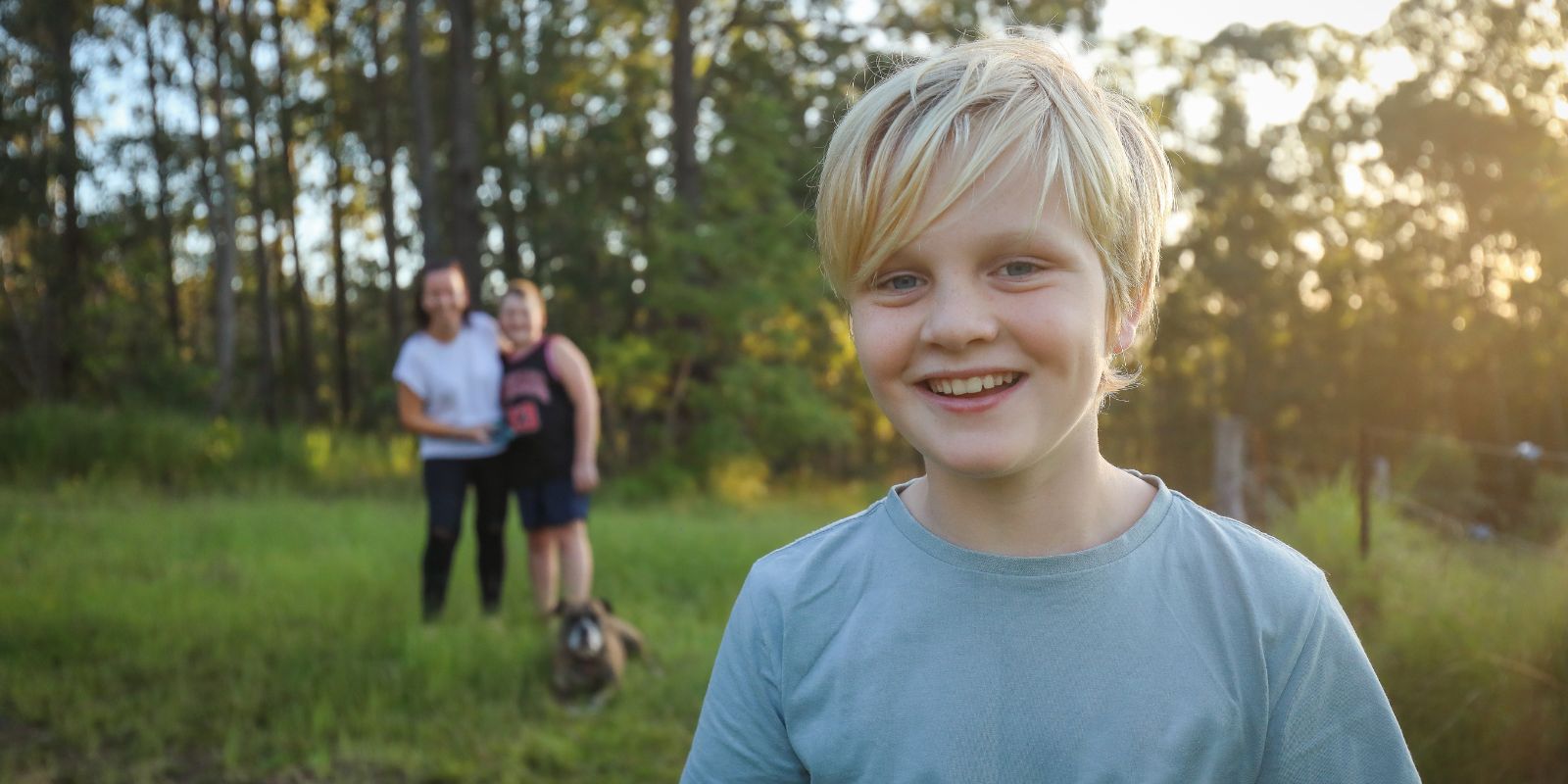
Parenting Challenges
Foundations for Safe Parenting
Free Australia-wide webinar exploring family and dv, coercive control, child wellbeing and practical safe parenting strategies.

Parent Wellbeing
Self-Care in Tough Times
Simple strategies to manage stress, build resilience and prioritise your wellbeing during challenging times.
Courses Coming Up